
Wabaunsee County Criminal Court Records
A criminal court record begins when a criminal case is opened in Wabaunsee County District Court. The file may include the complaint or information, charge statutes, arrest warrant or summons, bond entries, first appearance, counsel appointment, preliminary hearing records, arraignment, pleas, motions, orders, docket events, journal entries, disposition, sentence, probation terms, fines, costs, restitution, and warrants tied to failure to appear or probation violations. The Clerk of the District Court is the court-file custodian.
Wabaunsee County is part of the Kansas 2nd Judicial District. Kansas district courts are trial courts of general original jurisdiction, so felony criminal cases and many county-level misdemeanor or traffic-criminal matters are handled through District Court. Municipal courts are separate city courts for ordinance violations and many city traffic matters. A municipal charge may not appear in the same place as a district court criminal case unless it is appealed or otherwise reaches district court.
Search Wabaunsee County Criminal Cases
Search filed criminal cases through Kansas CaseSearch or the Kansas District Court Public Access Portal. A case number is the best search key. If the case number is not known, use the defendant name, citation number, business name if applicable, or other allowed criteria. The public portal may show events and hearings even when documents are limited or unavailable to anonymous public users.
- Start with the case number from a summons, citation, bond paper, warrant, or court notice.
- If no case number is known, search by defendant name and narrow by Wabaunsee County or the correct court location.
- Review the criminal case docket for filed charges, bond activity, hearings, motions, pleas, and orders.
- Check the disposition and sentence fields carefully, since each charge can have a different result.
- Request certified copies from the Clerk of the District Court when a signed order or official case document is needed.
Payable criminal cases may also appear in the KSCourts Central Payment Center, which searches by citation or case number, driver-license information, name, or business name. Payment eligibility is not the same as full criminal-record access. It can show that a case has payable costs, but it may not show every motion, order, sentence term, or sealed entry.
Wabaunsee County Criminal Case Flow
A criminal case file should be read as a timeline. Charges may be filed after an arrest or by summons. A first appearance and bond entry can follow. Felony cases may include preliminary hearing activity before arraignment. Motions and orders may shape what evidence can be used or how the case proceeds. The case then ends by plea, trial verdict, dismissal, or another court-approved disposition, followed by sentencing when there is a conviction.
Case flow: Charges Filed › First Appearance › Arraignment › Pretrial and Motions › Plea or Trial › Disposition › Sentencing
| Stage | What Happens |
|---|---|
| Charges Filed | The County Attorney files a complaint or information, and the case becomes a court record. |
| First Appearance | The defendant appears before the court, bond may be addressed, and future dates are set. |
| Arraignment | The defendant is formally advised of charges and enters a plea. |
| Pretrial and Motions | Parties file motions, request orders, exchange required materials, and prepare for plea or trial. |
| Plea or Trial | The case resolves by plea, verdict, dismissal, or another court-approved result. |
| Disposition and Sentencing | The record shows the outcome and any jail, probation, fines, costs, restitution, or conditions. |
Wabaunsee Criminal Court Record Fields
Criminal court records can be more detailed than a public summary. A docket line may identify a plea or order, while the underlying document explains the exact terms. When reading a Wabaunsee County criminal court record, separate the charge list from the case result. One defendant can have several counts, and each count may be amended, dismissed, pled, tried, or sentenced in a different way.
| Field | What It Shows |
|---|---|
| Case Number | The Kansas district court case identifier used to track the criminal file. |
| Defendant | The person charged in the criminal case, along with counsel information if public. |
| Filed Charges | The alleged offense, statute, severity level, count number, and amended charge history when shown. |
| Bond and Warrants | Bond amount, cash or surety references, warrant issue or recall, and failure-to-appear events. |
| Hearings | First appearance, preliminary hearing, arraignment, motion hearings, plea hearings, trial dates, and sentencing. |
| Plea | The defendant's response to a charge, such as guilty, not guilty, or another plea recognized by the court. |
| Disposition | The result for a charge or case, such as dismissed, guilty, acquitted, amended, or otherwise resolved. |
| Sentence | Jail, probation, fines, costs, restitution, treatment, no-contact terms, or other ordered conditions. |
| Documents | Complaint, information, motions, orders, journal entries, warrants, notices, and sentencing documents when public. |
Charges vs Convictions
A criminal charge is an accusation filed in court. A conviction is a final result based on a guilty plea, verdict, or other court finding of guilt. Wabaunsee County criminal court records can show charges that never became convictions. A charge may be dismissed, amended, reduced, merged, or resolved by a plea to a different count. Read the disposition for each count before treating a charge as an outcome.
| Point | Charge | Conviction |
|---|---|---|
| Meaning | An alleged offense filed by the prosecutor. | A finding or plea of guilt accepted by the court. |
| Record Stage | Appears early and can change during the case. | Appears after plea, verdict, or final adjudication. |
| Effect | Can support hearings, bond, motions, and plea talks. | Can support sentence, probation, fines, costs, and collateral consequences. |
| Reading Tip | Check amended and dismissed entries. | Check sentence and final judgment entries. |
County Attorney and Defense Counsel
Wabaunsee County uses a County Attorney title rather than District Attorney in the captured county source. The County Attorney is the local prosecution contact for state criminal charges filed in Wabaunsee County District Court. The County Attorney page identifies Timothy Liesmann and lists the office at the Wabaunsee County Courthouse. Prosecutor filings are not the same as court clerk records, but they are the source of formal charges that become part of the criminal case file.
The manifest image source for this topic includes the U.S. Attorney for the District of Kansas, which is relevant only when a matter is federal rather than Wabaunsee County District Court.
Federal criminal cases do not appear in Wabaunsee County District Court files. They are handled through federal court systems such as PACER and the District of Kansas clerk.
Public defense for people who cannot afford counsel is handled through Kansas Board of Indigents' Defense Services or assigned-counsel procedures. A Wabaunsee-specific public defender office was not located in the captured official sources, so appointment questions should be raised in District Court.
Sealed vs Expunged Records
Kansas criminal records can be restricted by sealing, expungement, statute, rule, or court order. Expungement is petition-based. A person normally files in the court where the case occurred, pays the required filing fee unless waived, gives required notice, and waits for the court to decide eligibility. Some offenses have waiting periods, and some are not eligible. Expungement limits public access, but courts, prosecutors, law enforcement, licensing bodies, and other authorized agencies may still have access for specific purposes.
| Point | Sealed Record | Expunged Record |
|---|---|---|
| Main Effect | Hidden from ordinary public access by law or court order. | Public access is limited after a successful statutory petition. |
| How It Happens | By statute, rule, or judge's order. | By filing an eligible expungement petition under Kansas law. |
| Who May Still See It | Courts or authorized agencies depending on the rule or order. | Courts, prosecutors, law enforcement, licensing bodies, or other authorized users may retain access. |
| Wabaunsee Contact | Clerk of the District Court for cases filed there. | Wabaunsee County District Court for local cases and order follow-up. |
The manifest assigns the Kansas criminal expungement statute as an image source through K.S.A. 21-6614.
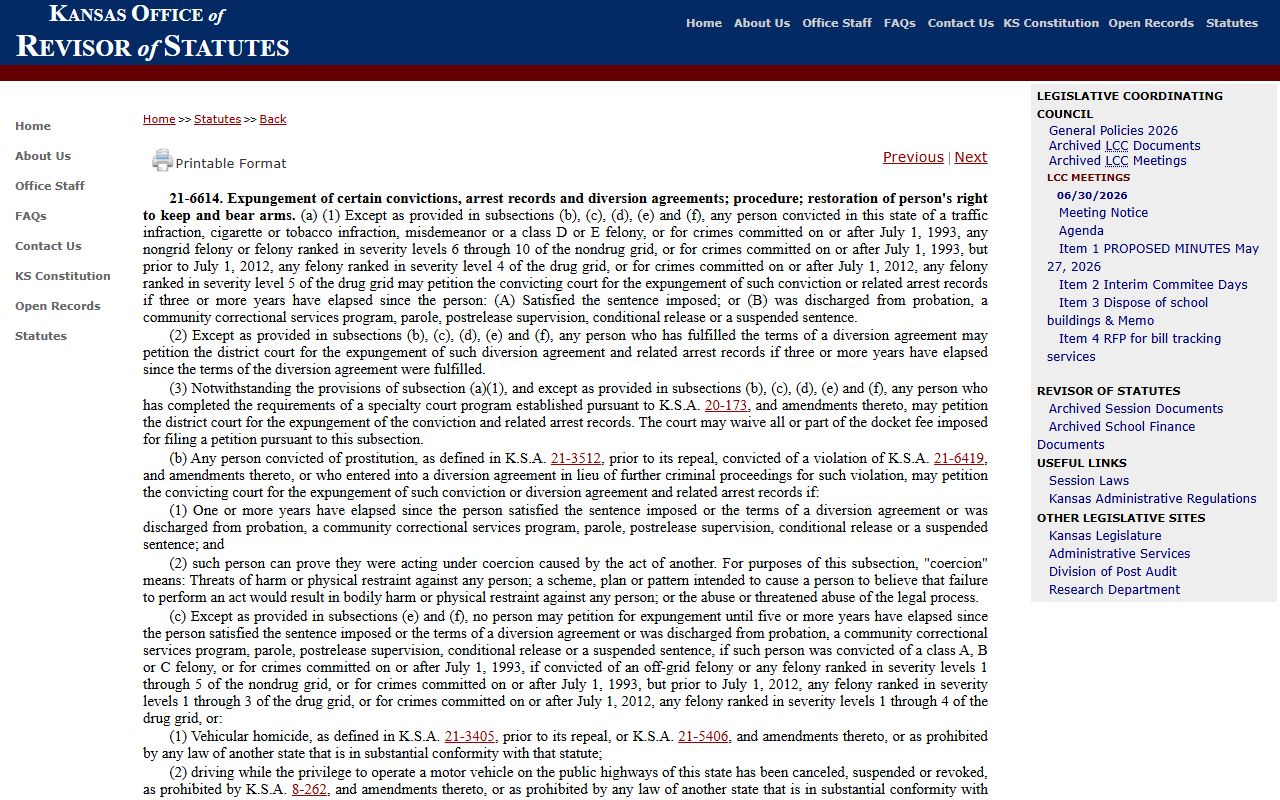
That statute is central to adult criminal conviction, arrest-record, and diversion expungement requests tied to cases in Kansas district courts.
Public Access to Wabaunsee Criminal Records
Kansas public access to criminal court records comes from the same split framework used for other court files. The Kansas Open Records Act governs many public records, while Kansas Supreme Court rules govern electronic district court case access. K.S.A. 45-218 addresses public-record inspection and agency response duties. Rule 106B and Rule 22 shape electronic court-record access and confidentiality.
Restricted criminal information includes juvenile matters, sealed cases, expunged records, protected victim details, personal identifiers, financial account numbers, and some criminal-investigation records. A public criminal case summary may confirm that a case exists while withholding documents or data fields. Certified copies, older files, and questions about missing or sealed entries should be directed to the Clerk of the District Court.
Note: A criminal case file can show dismissed charges, amended counts, or acquittals, so dispositions must be checked count by count.